
Company
Raubex Construction
Location
Mokhotlong, Kingdom of Lesotho
Client
Lesotho Highlands
Development Authority /
LHWP Phase II
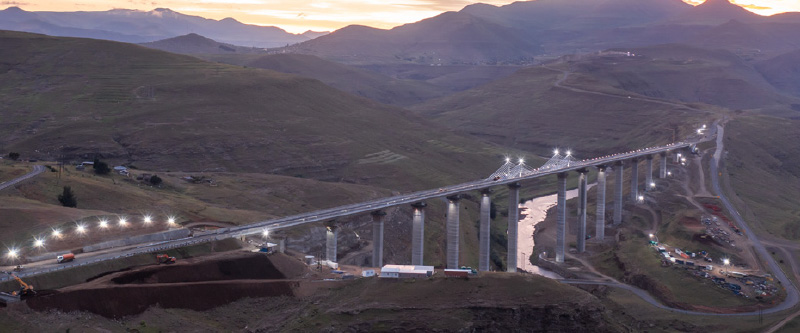
The Senqu Bridge Project forms a critical component of Phase II of the Lesotho Highlands Water Project (LHWP) and represents one of the most significant civil engineering undertakings currently under construction in Southern Africa.
Located in Mokhotlong, Kingdom of Lesotho, the bridge has been developed to ensure long-term connectivity across the Senqu River and the future Polihali Reservoir, supporting both the construction activities and the permanent infrastructure requirements of LHWP Phase II.
Raubex Construction is proud to be one of the primary South African partners involved in the delivery of this landmark project, contributing to infrastructure that supports regional integration, water security and sustainable socio-economic development.
Project Overview and Engineering Scope
Constructed at an approximate cost of R2.4 billion, the Senqu Bridge is the largest of three major bridges being delivered under LHWP Phase II, alongside the Mabunyane and Khubelu bridges. With a total length of approximately 825 metres and a height of 90 metres above the Senqu River, the bridge is among the most prominent infrastructure structures in the region.
The Senqu Bridge is the first extradosed bridge in Lesotho, incorporating a hybrid design that combines elements of cable-stayed and prestressed girder bridge technology. This design solution was selected to meet the project’s structural demands while accommodating the challenging mountainous terrain.
Construction was undertaken using an incremental launching method, a technique that enhanced safety performance and significantly reduced environmental disruption within the sensitive river valley.
Sustaining Long-Term Connectivity
The bridge plays a pivotal functional role within the LHWP infrastructure network. Following the completion of the Polihali Dam, rising water levels will submerge several existing river crossings. The Senqu Bridge has been specifically designed to ensure uninterrupted access along the A1 route, maintaining reliable connectivity between Mokhotlong, Maseru and surrounding communities.
This long-term access is essential not only for the operational requirements of the LHWP, but also for the continued mobility of local communities and access to essential services.
Socio-Economic Contribution
In addition to its technical complexity, the Senqu Bridge Project has delivered significant socio-economic benefits. Construction activities generated approximately 250 000 person-days of employment, with a peak workforce of around 1 200 workers, the majority drawn from local Basotho communities.
Procurement strategies emphasised inclusive participation, with meaningful involvement of local suppliers and contractors across both Lesotho and South Africa, including black-owned enterprises. This approach forms part of the broader LHWP objective to ensure that infrastructure investment delivers tangible local and regional economic benefits.
Part of the Lesotho Highlands Water Project
The Senqu Bridge forms part of the broader Lesotho Highlands Water Project, a multi-phased, treaty-based partnership between South Africa and Lesotho established in 1986. The project is designed to address long-term water security, energy generation and socio-economic development through the harnessing of the Orange–Senqu River system.
Phase II includes the construction of the Polihali Dam, a 165-metre-high concrete-faced rockfill dam, as well as a 38-kilometre transfer tunnel linking the Polihali and Katse reservoirs. Once completed, Phase II will increase water transfer capacity to South Africa from 780 million cubic metres to approximately 1 270 million cubic metres per annum, strengthening water security for the Gauteng region while delivering enduring infrastructure benefits to Lesotho.
Delivering a Legacy Asset
The Senqu Bridge Project stands as a legacy infrastructure asset, engineered to support the long-term objectives of one of Africa’s most ambitious cross-border infrastructure programmes.
For Raubex Construction, involvement in the project reflects a continued commitment to delivering complex, high-impact infrastructure that connects communities, enables economic growth and strengthens regional cooperation across Southern Africa.
Company
Raubex Construction
Location
Dardanelles (National Route 3, Section 2 between Cato Ridge I/C and Dardanelles)
Client
SANRAL

The Dardanelles project was awarded on 3 January 2021 (revised completion date: 5 June 2025) at a value of R2.046 billion (October 2023). The 53-month contract involves the upgrade of National Route 3, Section 2 between Cato Ridge I/C (km 20.200) and Dardanelles (km 26.600). Works include upgrading and constructing ramps and provincial roads, drainage systems, retaining walls, road widening, bridge rehabilitation, new structures, median barriers, road sign gantries, and asphalt surfacing. Major structures include two retaining walls, a rail underpass, central pile foundations for a future bridge, and multiple bridge rehabilitations.
Company
Raubex Construction
Location
Karino to Mara (Maputo Development Corridor, Section 9, N4 Toll Road)
Client
TRAC

The Karino Interchange project was awarded on 8 March 2019 and completed on 30 September 2022, with a final value of R397.35 million. It formed part of the Maputo Development Corridor (MDC) Section 9, a key trade route between Gauteng and Maputo harbour. Works included upgrading the existing single carriageway to a four-lane undivided dual carriageway between km 62.950 and km 66.250, constructing a grade-separated partial clover quad interchange at Karino, and relocating the Crocodile Valley intersection to integrate with the new interchange. Major works comprised widening the Karino Spruit Bridge, rehabilitating the Crocodile River steel bridge, building an agricultural underpass, and constructing a four-span Karino Interchange Bridge with a post-tensioned prestressed concrete twin spine deck. Additional works included widening the N4 carriageway over a 4 km section, upgrading three major structures, and carrying out blasting, earthworks, drainage, asphalt surfacing, and associated finishes.
Company
Raubex Construction
Location
Delivery Tunnel North (DTN) and Ash River, Lesotho Highlands Water Project (LHWP)
Client
Trans Caledon Tunnel Authority (TCTA)

The LHWP 2024 Shutdown project was awarded on 9 September 2024 for completion on 31 March 2025, valued at R357.82 million over a six-month contract period. The works involved inspection and repairs of the Delivery Tunnel North (DTN) and erosion protection to the Ash River. Key activities included pre-shutdown preparations such as load testing, pump installation, and valve repairs; grit blasting and relining of steel sections; inspection and repair of concrete-lined sections; refurbishment and reinstallation of valves in the dewatering shaft; gabion repairs and gunniting; inspection and repair of the Ash Outfall; installation of stop logs; and shaping and placing rip rap along Ash River banks. Additional work included gabion repairs at the Caledon Dewatering Shaft and new fencing installation at Little Caledon.
Company
Raubex Construction
Location
Dardanelles
Client
SANRAL

Dardanelles was awarded in October 2020 with an estimated completion date in May 2025. The R1.5 billion project requires Raubex to Upgrade and construct Ramps and Provincial Roads, Drainage, New structures, Retaining Walls, Widening of the N3 underpass structures and Gantry Signs.

Companies
Raubex Building and Raubex Construction
Location
Beitbridge, Zimbabwe
Client
Zimborders

Zimborders was awarded a Build, Operate and Transfer project by the Republic of Zimbabwe for the expansion, upgrading, improvement and modernization of the Zimbabwean border post at Beitbridge. Raubex was appointed by Zimborders as the EPC Contractor to execute the construction works.
Construction works includes the separation of traffic into three traffic streams namely freight, busses and light vehicles that includes pedestrians. Each traffic stream has its own new immigration terminals, new freight warehousing, scanner facilities and services infrastructure to compliment the new buildings. The project also includes infrastructure improvements in the town of Beitbridge that includes a new 11.4Ml reservoir, 220 staff housing units, a new fire station, animal quarantine facility and an oxidation dam.